How to Read a Window Film Datasheet and Verify IRR
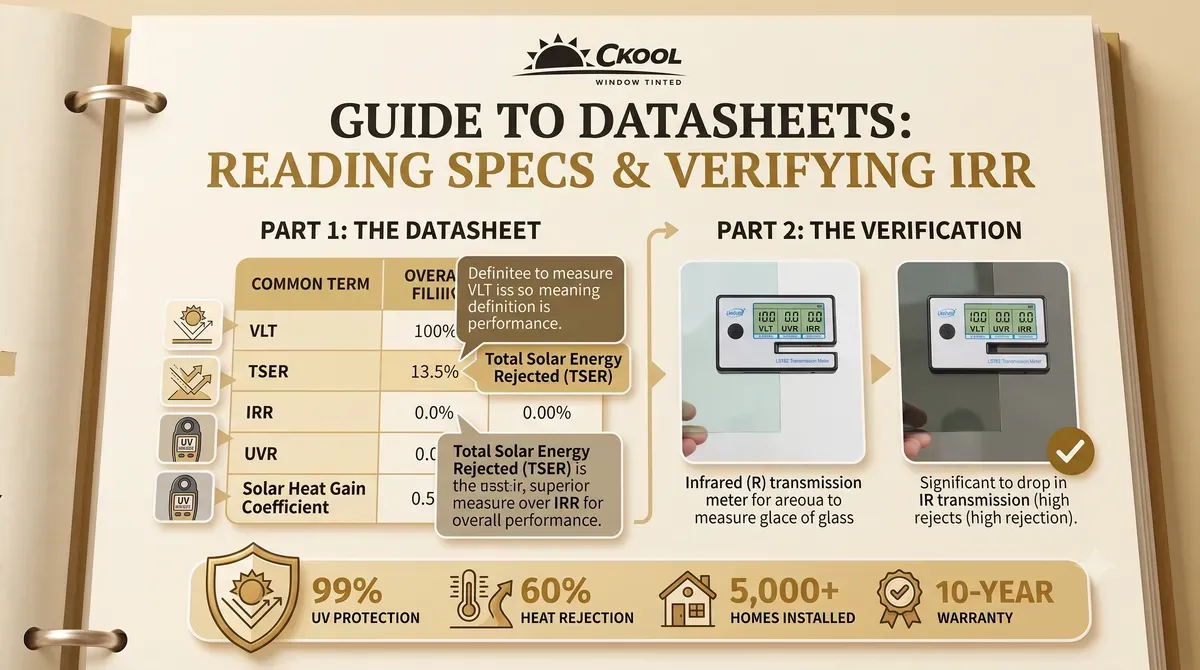
TL;DR: Checking a window film's specifications requires cross-referencing its visible light transmission (VLT), total solar energy rejected (TSER), and infrared rejection (IRR) on the official manufacturer datasheet. Verify these numbers using a pocket solar transmission meter during installation to ensure you are receiving the exact performance values you paid for.
What is a window film datasheet?
A window film datasheet is a technical document provided by manufacturers that lists the precise optical and thermal performance metrics of a window film, tested in accordance with international standards. These specifications outline how much light passes through the glass, how much ultraviolet radiation is blocked, and the percentage of solar heat that is reflected or absorbed.
Why verifying datasheet IRR matters
Because infrared radiation represents nearly half of solar heat, the Infrared Rejection (IRR) rating directly indicates a film's performance in warm climates. Verifying these specs prevents you from purchasing budget dyed tints rebranded as premium heat-blocking ceramic films.
Spotting Inflated IRR Claims
Some unbranded films claim an IRR of 99% but only measure this rejection at a single narrow wavelength, whereas official datasheets measure across the entire solar spectrum.
Understanding TSER vs. IRR
A film with 95% IRR does not reject 95% of total heat. Always verify the Total Solar Energy Rejected (TSER) value, which accounts for the entire solar energy range.
How to read and understand datasheet parameters
When examining a datasheet, look for the following standardized metrics to evaluate the performance of different film types, including Nano-Ceramic, Sputtered, Reflective, Carbon, Dyed, Security, Frosted, and Decorative options.
Visible Light Transmission (VLT)
The percentage of visible light that passes directly through the glass. A VLT of 70% is nearly clear, whereas a VLT of 5% is a dark "limo tint." Darker shades reduce glare but restrict visibility during overcast conditions.
Infrared Rejection (IRR)
This measures the percentage of infrared radiation (780nm to 2500nm) blocked by the film. Premium nano-ceramic and sputtered films maintain high VLT levels while achieving an IRR of 90% or above.
Ultraviolet Rejection (UVR)
The percentage of harmful UV-A and UV-B rays blocked. Most professional solar, safety, and decorative films block 99% UVR to protect your skin and prevent furniture fading.
Total Solar Energy Rejected (TSER)
The overall percentage of heat energy deflected away from the glass. TSER includes infrared, ultraviolet, and visible light spectrums, and is the ultimate metric for comparing solar heat protection.
Typical specifications of home window films
Below are typical performance specs across film classes, including solar, safety, and decorative options.
| Film Type | Typical IRR | Typical VLT | Typical TSER | Primary Purpose |
|---|---|---|---|---|
| Nano-Ceramic | 90% - 99% | 30% - 70% | 50% - 65% | Max Heat Rejection & Clarity |
| Sputtered | 80% - 90% | 20% - 55% | 55% - 70% | Durable Solar Control |
| Reflective | 70% - 85% | 10% - 35% | 60% - 75% | Privacy & High Glare Rejection |
| Carbon | 60% - 75% | 15% - 50% | 40% - 55% | Fade-Resistant Color |
| Security Film | 30% - 90% (Varied) | 50% - 85% | 35% - 55% | Glass Shatter Protection |
| Dyed | 10% - 30% | 5% - 50% | 25% - 35% | Basic Shade & Low Budget |
| Frosted & Decoration | 10% - 20% | 10% - 60% | 15% - 30% | Interior Privacy & Aesthetics |
Practical steps to verify film parameters
- Ask for the brand datasheet: Request the official manufacturer performance sheet instead of a generic leaflet printout.
- Check the brand watermark: Authentic premium films often feature light manufacturer watermarks printed on the liner that can be verified before installation.
- Use a digital solar meter: Ask the installation technician to test the sample film on a digital light transmission meter to verify VLT, UVR, and IRR percentages.
- Cross-reference standard tests: Ensure the datasheet states standard testing parameters, such as NFRC (National Fenestration Rating Council) standards.
Common mistakes when checking film parameters
- Accepting verbal guarantees: Never rely on sales pitches claiming "maximum heat rejection" without a verified technical sheet showing TSER and IRR.
- Confusing single-wavelength IRR with overall IRR: Cheap films often advertise 99% IRR measured strictly at 950nm, while their heat rejection drops drastically outside that wavelength.
- Ignoring UVR testing range: Ensure UV rejection covers the entire 300nm to 380nm ultraviolet range to guarantee true material protection.
Frequently asked questions about checking window film parameters
Q: How do you verify if window film is genuinely ceramic?
You can verify ceramic film by testing it with an infrared transmission meter during installation. Genuine nano-ceramic films reject over 90% of infrared radiation while maintaining high optical transparency.
Q: What is a solar transmission meter and how is it used?
A solar transmission meter is a pocket digital tester that measures visible light, ultraviolet, and infrared penetration through a glass sample. It provides real-time validation of datasheet metrics.
Q: What does a high VLT and low IRR combination mean?
This combination describes basic, light-colored films (like decorative or low-grade dyed films) that let in natural light but offer almost no solar heat block.
Q: Can window film specifications change over time?
Yes. While ceramic and metalized sputtered films remain stable, dyed films lose their heat rejection and fade under direct sunlight within two to three years.
Q: Where can I find standard window film datasheets?
Manufacturer datasheets are available directly on the official brand websites or from authorized tint installers upon request.
Conclusion
Understanding how to read a window film datasheet is key to getting the heat protection you pay for. Avoid relying on simple marketing labels; focus instead on verified specifications like IRR, VLT, and TSER. Using a digital solar transmission meter before the installation is complete is the most reliable way to check that you are receiving high-performance ceramic or sputtered window film.