Nano Ceramic vs Magnetron Sputter Window Film: Which is Best for Malaysian Homes?
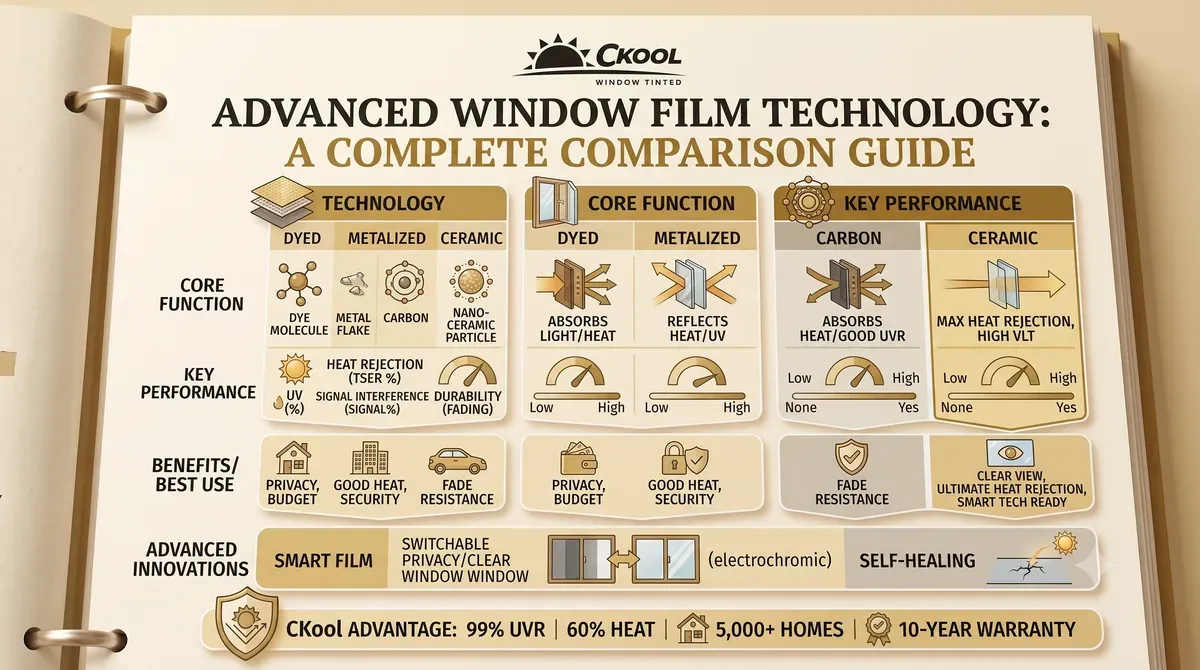
Quick Verdict (TL;DR): For living rooms, home offices, and high-rise condominiums with smart locks or Wi-Fi routers near windows, Nano Ceramic (e.g. Ckool NC Elite) is the superior choice because it absorbs solar heat without interrupting wireless signals or causing night-time interior mirror reflection. For large west-facing sliding doors, double-volume glass voids, and bungalows exposed to punishing afternoon heat (Barat), Magnetron Sputter (e.g. Ckool SP Signature) offers unbeatable, long-term heat reflection and lower Total Solar Energy Transmission (TSER).
The Core Physical Difference: Heat Absorption vs Heat Reflection
When comparing ceramic and sputter films, you are fundamentally choosing between two completely different thermodynamic mechanisms:
Nano Ceramic: Heat Absorption
Infused with microscopic, non-conductive ceramic nanoparticles (such as TiN - Titanium Nitride or ATO - Antimony Tin Oxide). These particles capture and absorb solar infrared wavelengths before they penetrate the room. Because ceramics are non-metallic, they have zero electronic interference.
Magnetron Sputter: Heat Reflection
Manufactured in high-vacuum plasma chambers where atomic layers of rare metals (such as silver, gold, nickel-chromium, and titanium) are deposited onto the polyester film. These metal layers bounce solar infrared energy directly back into the atmosphere like a microscopic mirror.
Head-to-Head Performance Comparison
How nano ceramic and magnetron sputtered films stack up across critical Malaysian residential criteria:
| Evaluation Criteria | Nano Ceramic (e.g. Ckool NC Series) | Magnetron Sputter (e.g. Ckool SP Series) | Winner / Recommendation |
|---|---|---|---|
| Infrared Rejection (IRR) | 90% - 99% | 85% - 96% | Tie (Both deliver high heat cut) |
| Total Solar Energy Rejected (TSER) | 52% - 66% | 60% - 76% | Magnetron Sputter (Higher overall heat block) |
| Wi-Fi, 5G & RFID Signal | 100% Zero Signal Loss | Slight signal attenuation possible | Nano Ceramic (Ideal for smart homes) |
| Night View & Interior Reflection | Low (8% - 10%) Natural View | Moderate (12% - 16%) Soft Sheen | Nano Ceramic (Better nighttime outdoor view) |
| Long-Term Heat Saturation | Glass warms up after 4+ hrs direct sun | Glass stays cooler (Active reflection) | Magnetron Sputter (Better for west-facing glass) |
| Average Price per Sq Ft (Malaysia) | RM 10 - RM 16 / sqft | RM 16 - RM 28 / sqft | Nano Ceramic (More budget-friendly) |
When Should You Choose Nano Ceramic Window Film?
- High-Rise Condominiums: Condos frequently place Wi-Fi modems, smart security locks, and IoT devices near balcony glass. Ceramic film ensures complete signal transparency.
- City View Living Rooms: If you enjoy looking at the city skyline or KLCC night lights without seeing your interior lights mirrored back at you, ceramic's low visible light reflection (VLR) is essential.
- North and East-Facing Facades: Morning sun is less punishing than afternoon sun. Nano ceramic provides more than enough thermal insulation while saving on installation cost.
- Cost-Conscious Full-Home Installations: At RM 10–RM 16 per sq ft, full installation for a typical 2-storey terrace house costs around RM 2,000–RM 3,500, offering exceptional price-to-performance value.
When Should You Choose Magnetron Sputter Window Film?
- Severe West-Facing Afternoon Heat (Matahari Barat): Malaysian afternoon sun (2:00 PM to 6:30 PM) delivers extreme radiant thermal energy. Sputter films actively reflect this heat away, keeping the glass surface significantly cooler.
- Double-Volume Glass Voids & Skylights: Tall living room glass walls accumulate enormous heat traps. Sputter films boast higher TSER ratings (up to 75%+), preventing heat buildup near the ceiling.
- Bungalows & Semi-Detached Residences: Freestanding properties without adjacent buildings to block the sun gain maximum energy efficiency and air conditioning savings with sputtered heat-reflective films.
- Demanding Durability Needs: In terms of oxidation and degradation resistance, magnetron sputtered films manufactured with non-corrosive alloys outlast standard films by over a decade.
The Pro Contractor Solution: The Smart Hybrid Tinting Strategy
Many experienced homeowners in Malaysia don't choose just one film for the entire house. Instead, they implement a room-by-room hybrid strategy:
West-Facing Living Room Balcony & Master Bedroom: Install high-spec Ckool SP Signature Magnetron Sputter to deflect harsh afternoon heat.
Home Office, Kitchen, & Dining Area: Install Ckool NC Elite Nano Ceramic to preserve natural light, ensure perfect Wi-Fi connectivity, and optimize overall budget.
Bathroom & Ground Floor Glass: Add Ckool Frosted or Security Tint for privacy and shatter protection.
Frequently Asked Questions (FAQ)
Q: Does ceramic window film turn purple over time?
No. Only cheap dyed films turn purple because organic dyes decompose under UV rays. True inorganic ceramic crystals (Titanium Nitride) do not fade or change color even after 10+ years of Malaysian sun exposure.
Q: Will magnetron sputter film make my home look like a commercial office building?
No, not modern magnetron sputter films. Unlike old-fashioned silver reflective films with 30%+ mirror reflectivity, architectural magnetron films deposit atomic-thin alloy layers that keep exterior reflectivity to a sophisticated 12%–16% sheen.
Q: Can I combine ceramic and sputter films in the same property?
Yes, absolutely. A hybrid strategy is the most cost-effective way to achieve maximum heat reduction where needed most while keeping costs manageable.
Conclusion
Both Nano Ceramic and Magnetron Sputter represent top-tier window film technology. If your primary priorities are zero electronic interference, natural views, and cost efficiency, Nano Ceramic is your best pick. If your home faces relentless afternoon heat and you need the absolute maximum solar heat barrier, Magnetron Sputter is well worth the investment.
Want to test both films directly on your windows?
Ckool provides on-site demonstrations with digital solar transmission meters across Kuala Lumpur & Selangor. Compare ceramic and sputter samples side by side on your glass.
Book a Free On-Site Measurement